Disastrous End to Zelensky's 40-Day Operation Exposes a Dwindling Ukraine
Today is the final day of Zelensky’s 40-day Special Military Operation, and it has come with ominous undertones. The carefully-constructed facade of success that was meant to drive the orchestrated PR campaign has been violently torn away to reveal a frail Ukraine trembling on its last hind legs.
Russia’s recent attack on Kiev revealed a catastrophic situation as Ukraine no longer has any Patriots to stop Russian ballistic missile attacks. The interception rate admitted-to by Kiev was as follows:
1/27 ballistic missiles of the 9M723 OTRK “Iskander-M” / KN-23;
0/2 anti-radar missiles Kh-31P;
0/4 anti-ship cruise and hypersonic cruise missiles 3M55 “Onyx” / 3M22 “Zircon”;
In total, 83.2% of UAVs have been neutralized.
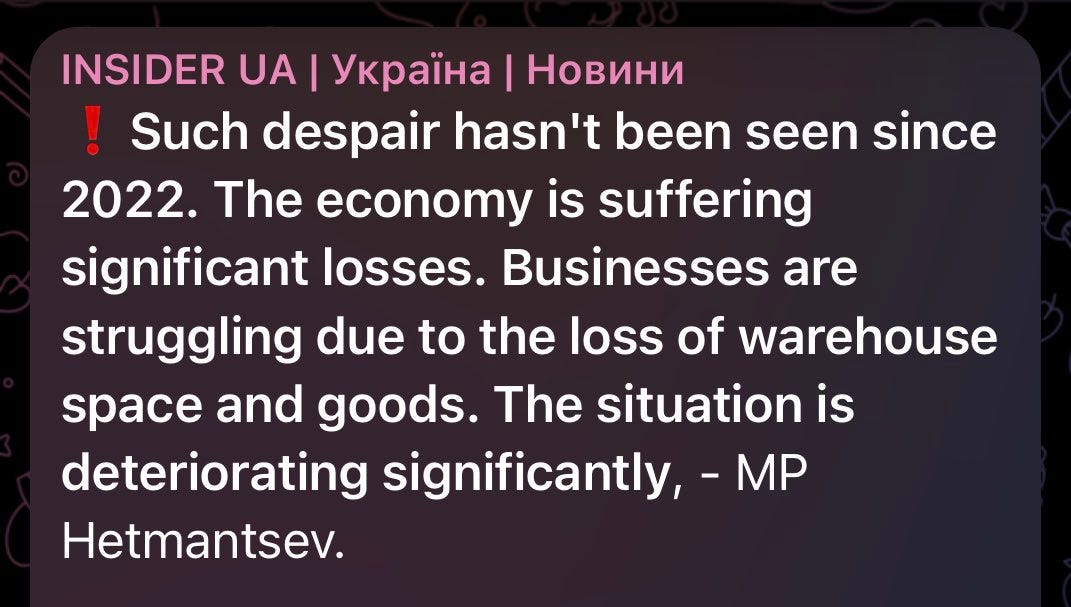
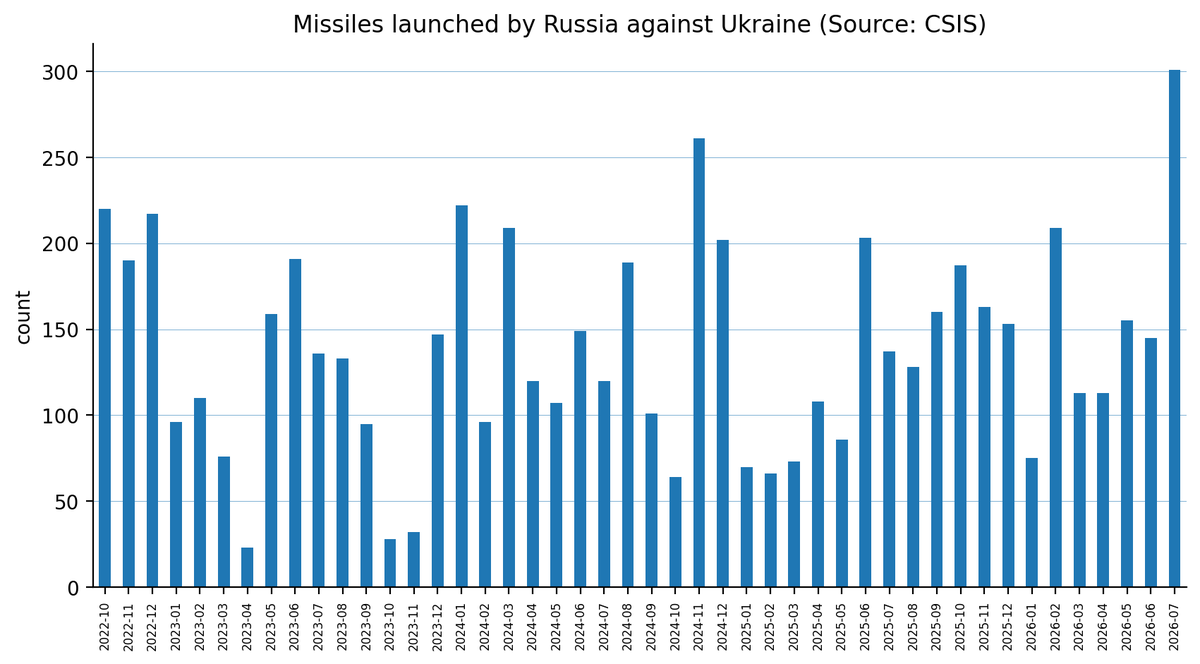
Top Ukrainian analyst channels now predict that Russia will soon go up from producing 70 ballistic missiles per month to over 150. This will leave Ukrainian infrastructure devastated as no current hope even exists for solving the Patriot problem, and no other available system besides the Patriot can engage Russian Iskanders.
Zelensky and his people know this, which is why now at the tail end of his failed 40-day operation he has begun begging Russia for a new ceasefire:
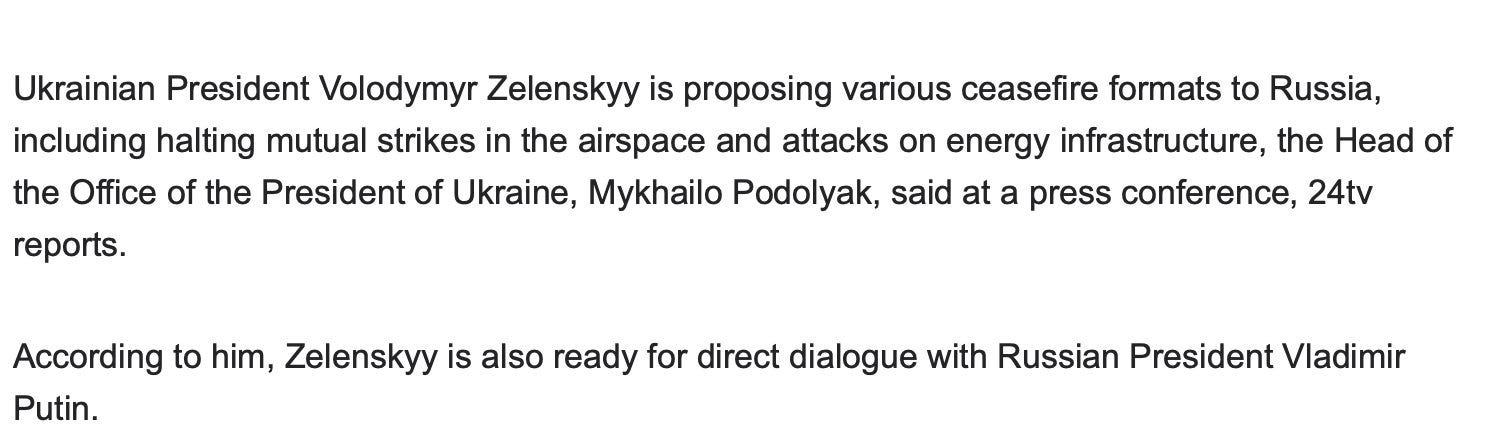
Interestingly, recall that just weeks ago Putin had revealed Ukraine was pleading with Russia for various types of ceasefires via secret back channels. People on the pro-UA side laughed and dismissed this—now it has become official reality, proving Putin rarely, if ever, lies about these things.
The other big reveal concerns something we predicted even here weeks ago when Ukraine first started having ostensible “successes” of some kind on the battlefield. The idea is that, any time Ukraine seems to advance or push Russian forces back, it is generally a short-lived effort where Ukraine expends a lot of saved-up resources and reserves which leads to immediate repercussions after the PR window closes.
Now many analysts are contending that this is exactly what happened recently. Zelensky strategically chose to use all his reserves of man and materiel for the 40-day PR operation to simulate some kind of initiative for a ‘victorious’ Ukraine so that allies could pressure Putin into ceasefire and negotiations. But now that this has failed, Ukraine is experiencing a precipitous front-line collapse where Russian troops have begun advancing faster than any recent time.
We may soon learn that Zelensky expended unsustainable levels of Ukrainian manpower in the first half of 2026 to create his "Ukraine turning the tide" PR campaign to try to win over Trump by the July NATO summit. And now the damage is coming due.
AMK Mapping 🇳🇿 @AMK_Mapping_
Over the last few weeks, the situation for Ukraine on the frontline has rapidly deteriorated in an unprecedented manner not seen since early 2025. In the northeastern corner Kharkiv Oblast, Russia has achieved two localised breakthroughs, threatening to encircle more than 360
8:10 AM · Aug 2, 2026 · 202K Views
28 Replies · 210 Reposts · 1.79K Likes
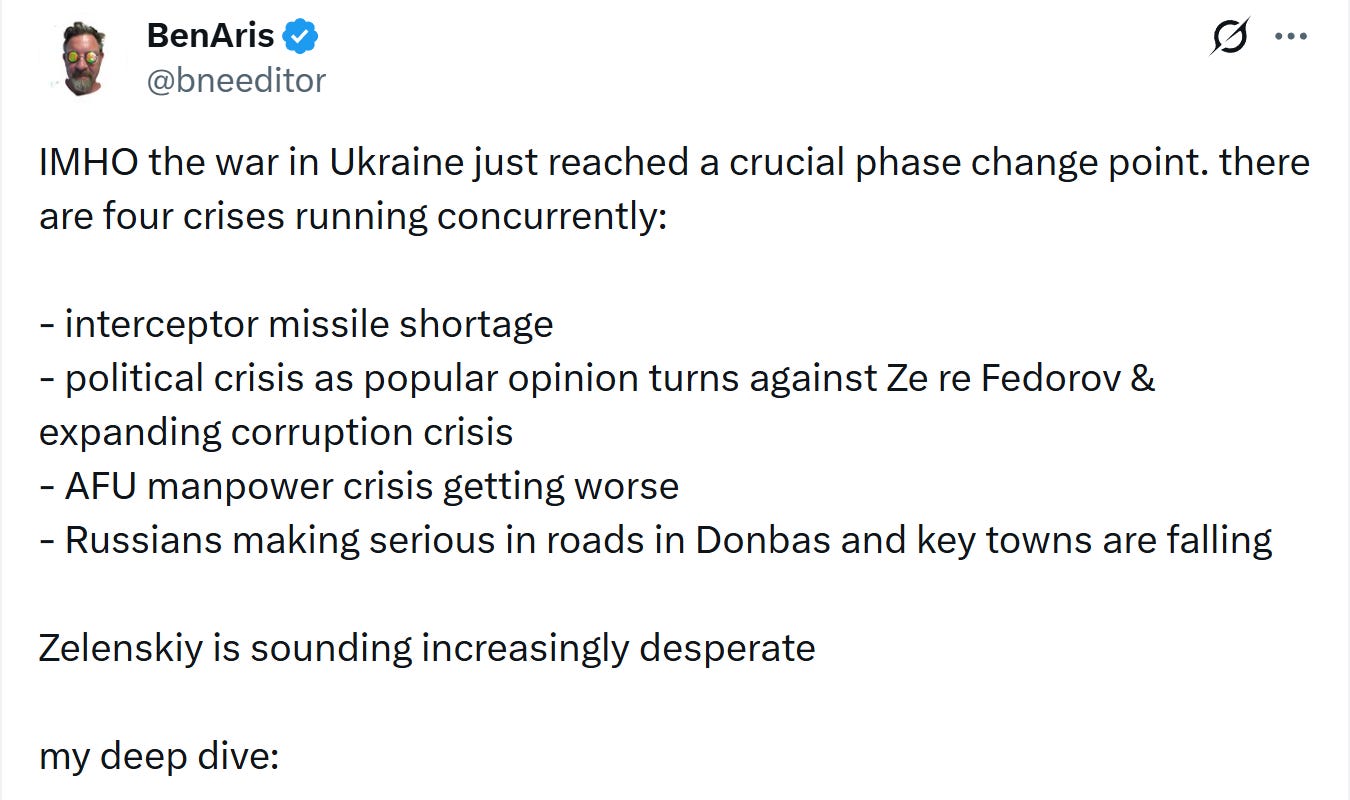
Lost Armour has revealed that Russian advances for July were the highest in virtually two years:
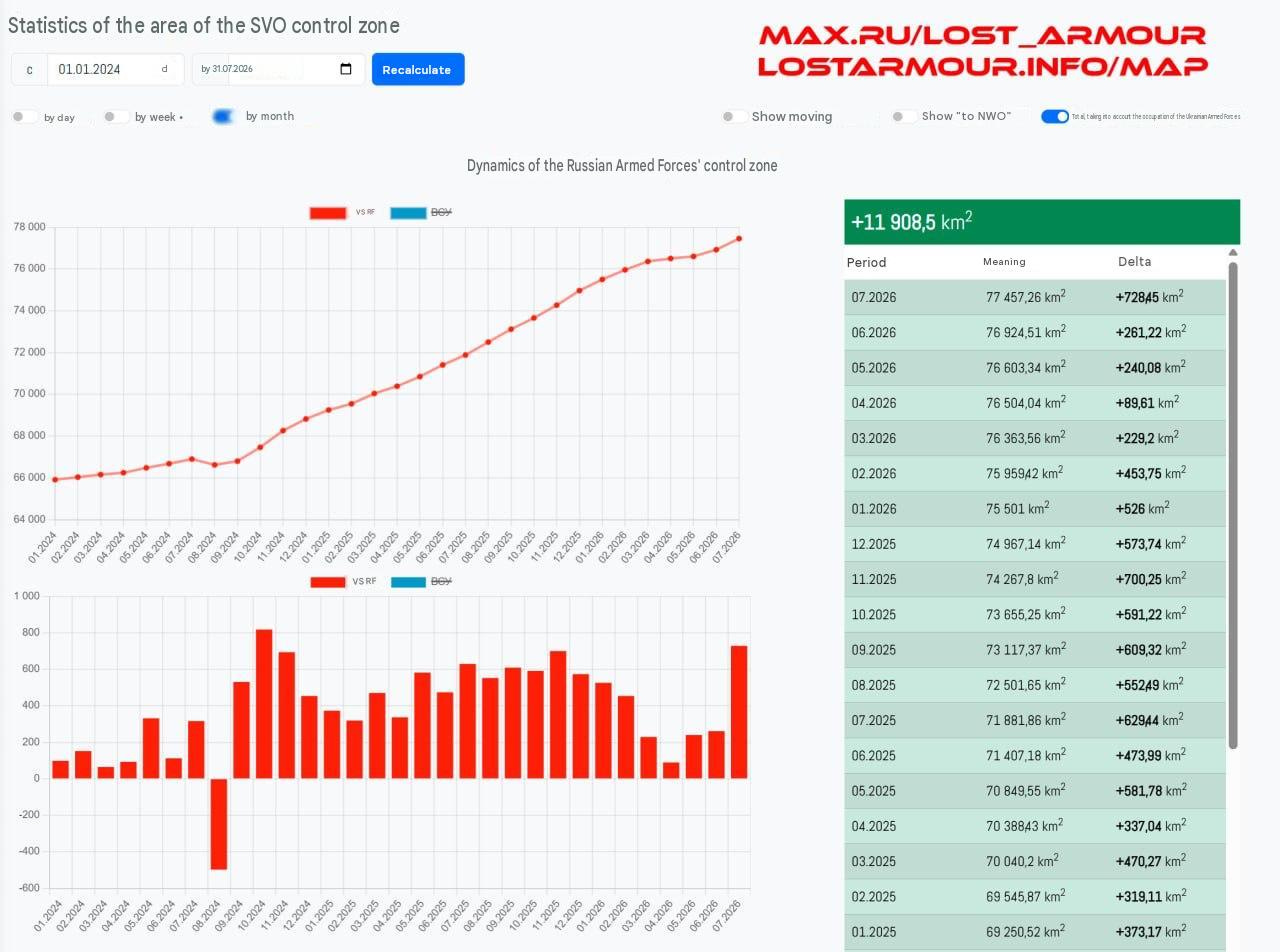
Russia recorded its highest rate of advance since October 2024.
Results for July 2026 on the map: the largest advance since October 2024 – over 728 km² of liberated territory.
In July 2026, the Russian Armed Forces liberated more than 728 km² of territory in the area of the special military operation, which is the highest monthly figure since October 2024.
As a caveat of journalistic due diligence, we must mention that other Russian sources like the prominent Creamy Caprice mapper have the July figure much lower than the above. But either way, it is clear to see on a daily level that Russian advances have been massively picking up on every front, from the north Kharkov-Sumy region, to Kupyansk and the Slavyansk-Kramatorsk agglomerate, down to the intersections of Zaporozhye-Dnipro-Donetsk.
From a popular American mercenary operating in Ukraine:
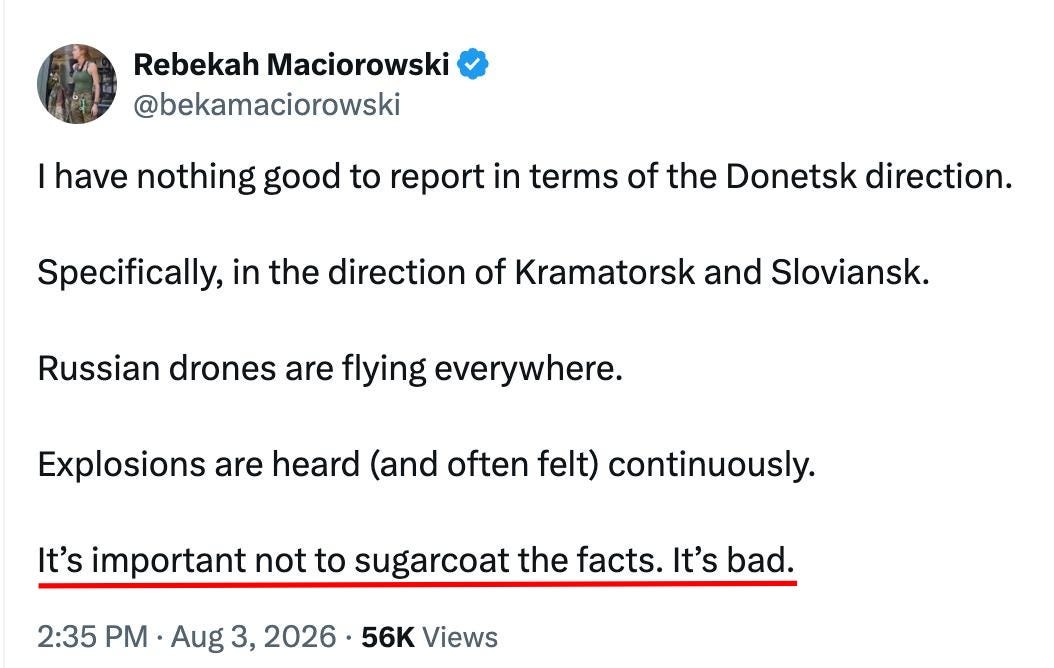
Hudson War Mapping 🇺🇦@hudsonwarmap
This is the inevitable consequence of useless counterattacks in far south Donetsk oblast. It is absolute negligence by the AFU command.
AMK Mapping 🇳🇿 @AMK_Mapping_
The situation on the Dobropillya direction is likely even worse than what my map currently shows. But I'm still clarifying certain details. https://t.co/zyTL05JiEa
5:06 AM · Aug 3, 2026 · 6.9K Views
5 Replies · 7 Reposts · 130 Likes
At the same time, the situation for Odessa has become worse than ever, with Russia having entirely landlocked Ukraine.
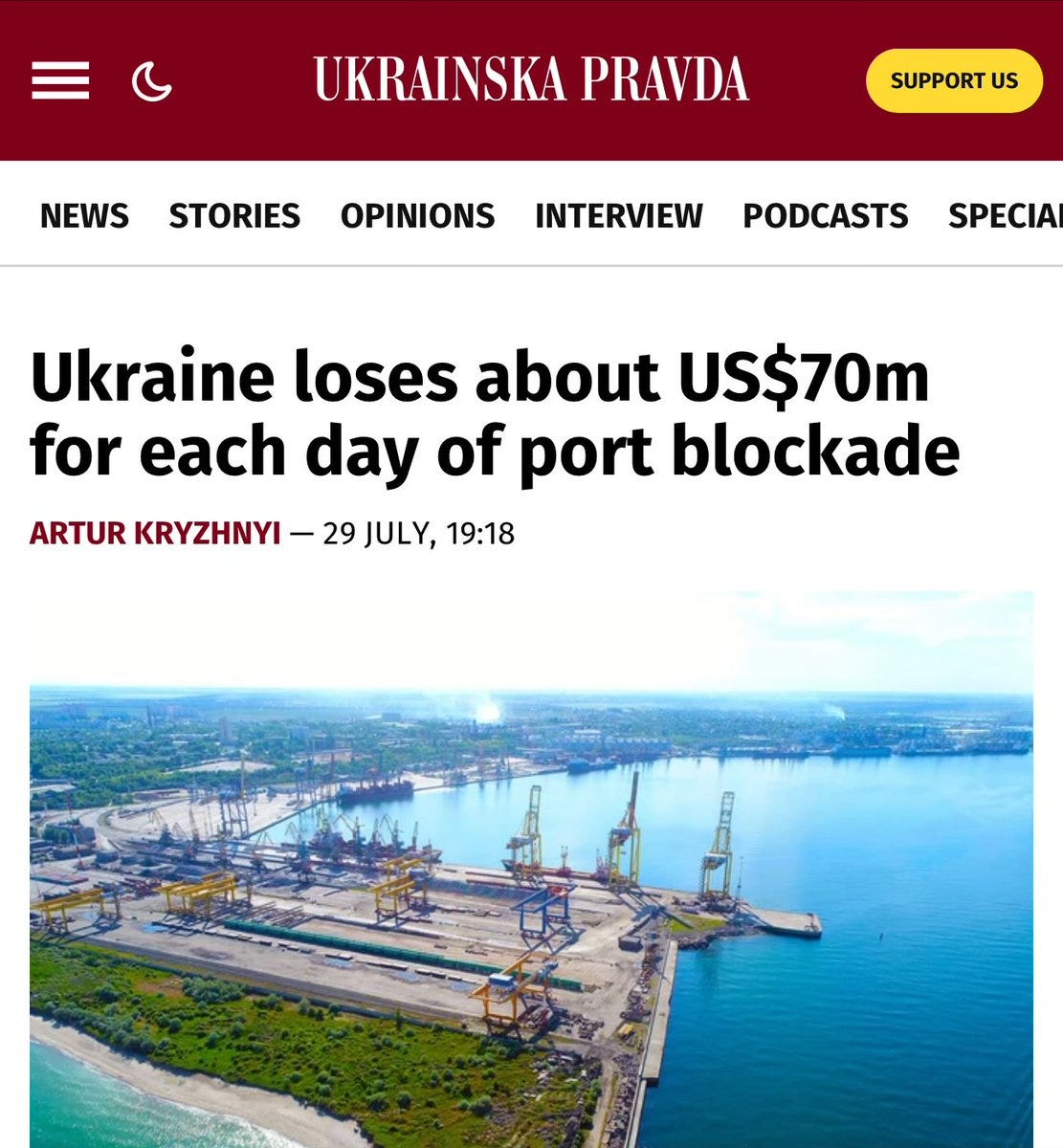
A Western journalist who just returned from the area reports:
Davide Maria De Luca@DM_Deluca
Sono appena tornato da Odesa, dove un'offensiva aerea senza precedenti da parte della Russia ha completamente bloccato i porti ucraini sul Mar Nero, minacciando un disastro economico che al momento appare sottovalutato dai media internazionali. In città si assiste a scene
6:40 AM · Aug 2, 2026 · 101K Views
122 Replies · 162 Reposts · 457 Likes
I just returned from Odesa, where an unprecedented Russian aerial offensive has completely blocked Ukrainian ports on the Black Sea, threatening an economic disaster that, at the moment, appears underestimated by international media.
In the city, one witnesses paradoxical scenes, with Russian drones and missiles flying over beaches full of swimmers, or being shot down off the coast, in view of thousands of smartphones pointed at the sky.
For about ten days now, Moscow has begun systematically targeting all vessels approaching the port, with no regard for nationality. Now, neither captains nor shipowners dare to approach the three major Ukrainian ports: Odesa, Chornomorsk, and Pivdenny.
For Ukrainian farmers, it risks being a disaster. With exports blocked at the peak of the harvest season, their warehouses are overflowing, and agricultural commodity prices in the country have collapsed. With the sunflower harvest starting in just a few days, the situation risks becoming critical.
One of the breakthroughs has been the use of Russia’s latest low-cost cruise missile, which some people call a missile-drone: the S8000 Banderol.
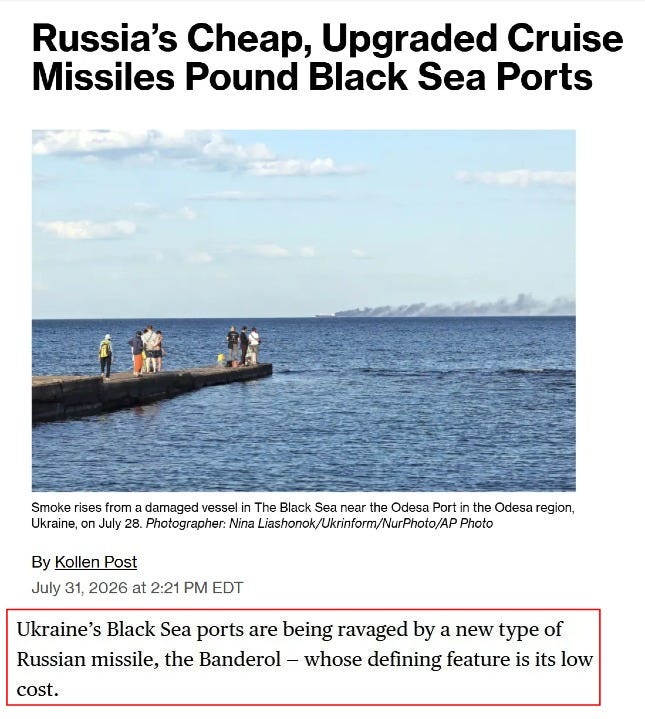
“This is a very dangerous gizmo,” Vlasiuk told journalists as he showed off part of a Banderol fired last year. “The majority of strikes on the port infrastructure in Odesa are with Banderols.”
Vlasiuk said his office determined that 80% of strikes on the ports of greater Odesa — including the neighboring Chornomorsk and Pivden — involved Banderols. The missile’s 150 kilogram (330 pound) warhead is bigger than that of Shaheds, and they fly at speeds too fast for Ukraine’s newest interceptor drones to catch.
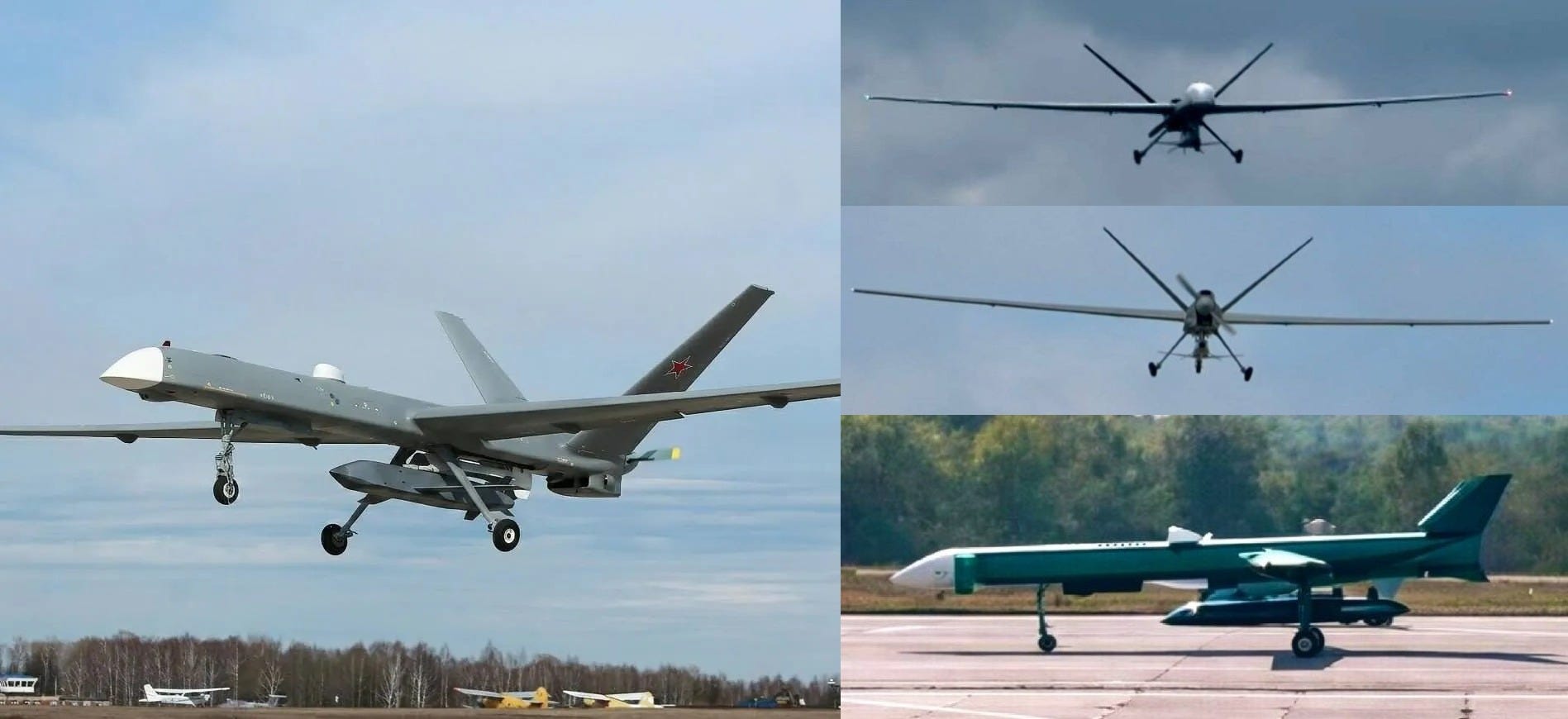
The missile is able to be launched by ground launchers, as well. But the true breakthrough comes from its usage via the Russian Orion or Inokhodets heavy drone, which allows Russia to get assets close to Odessa without having to risk valuable pilots and S-34 planes.
Orion seen with the Banderol attached:
All the while, the bad news simply continues to roll out for Ukraine. Multiple outlets report that Ukraine’s diplomatic and political gusto is waning.
El Pais writes that European sanctions against Russia have peaked, and that governments soon will increasingly begin prioritizing their own wellbeing over shooting themselves in the foot just to try and “hurt” Russia:
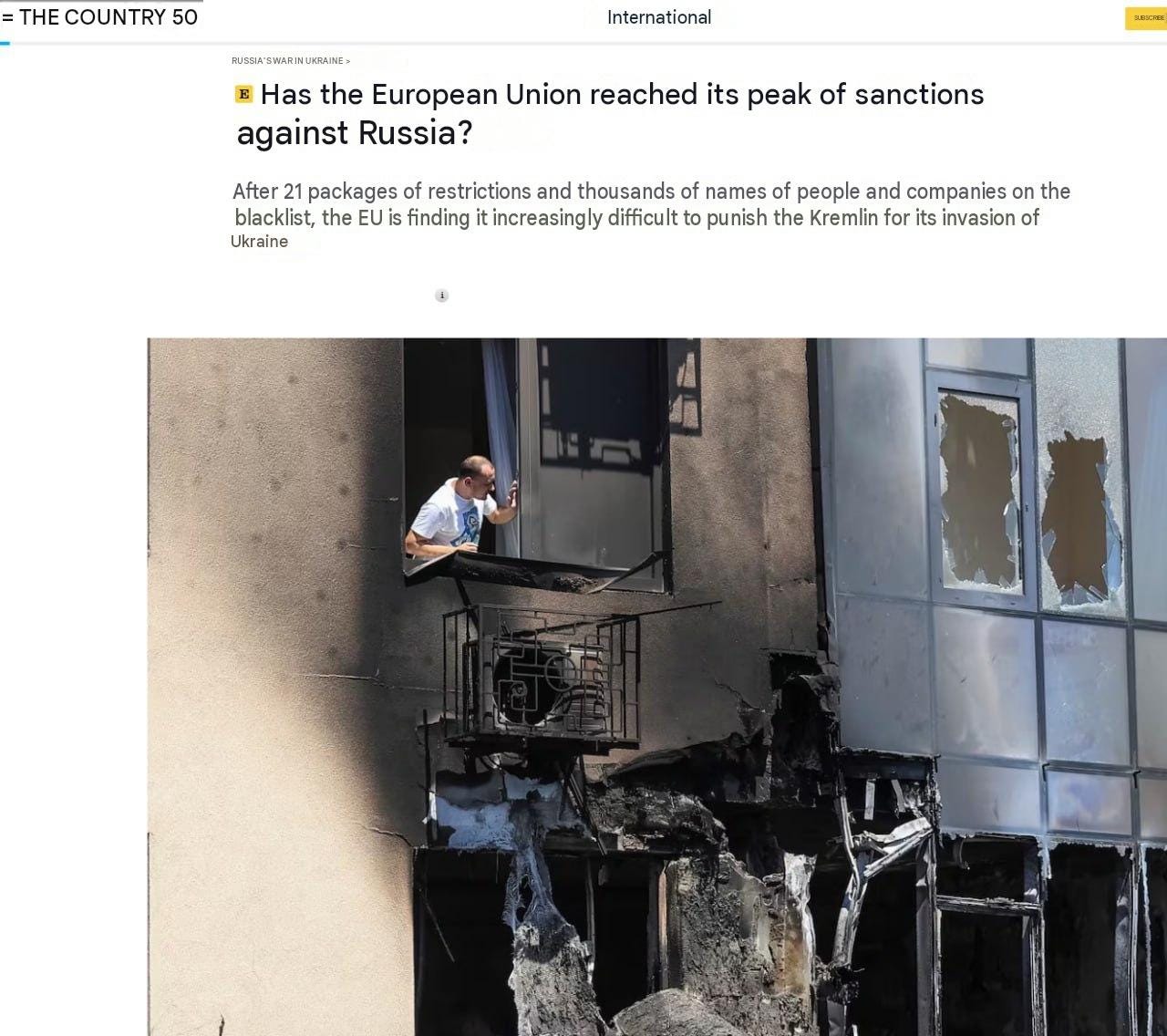
The EU is not far from reaching its “sanctions peak,” according to Jacob Funk Kirkegaard, a researcher at the economic think tank Bruegel—that is, the point at which governments begin to prioritize their national economic interests over new restrictions on Russia. “What’s left are, let’s say, some very thin slices of salami,” he explains in a phone conversation. The most sensitive measures—those that have been left untouched in two dozen previous rounds of sanctions—are usually precisely those that a member state has a reason to block—and the actual power to veto, since sanctions are approved unanimously.
Telegraph likewise warns that the entire coalition for helping Ukraine is on its death bed:
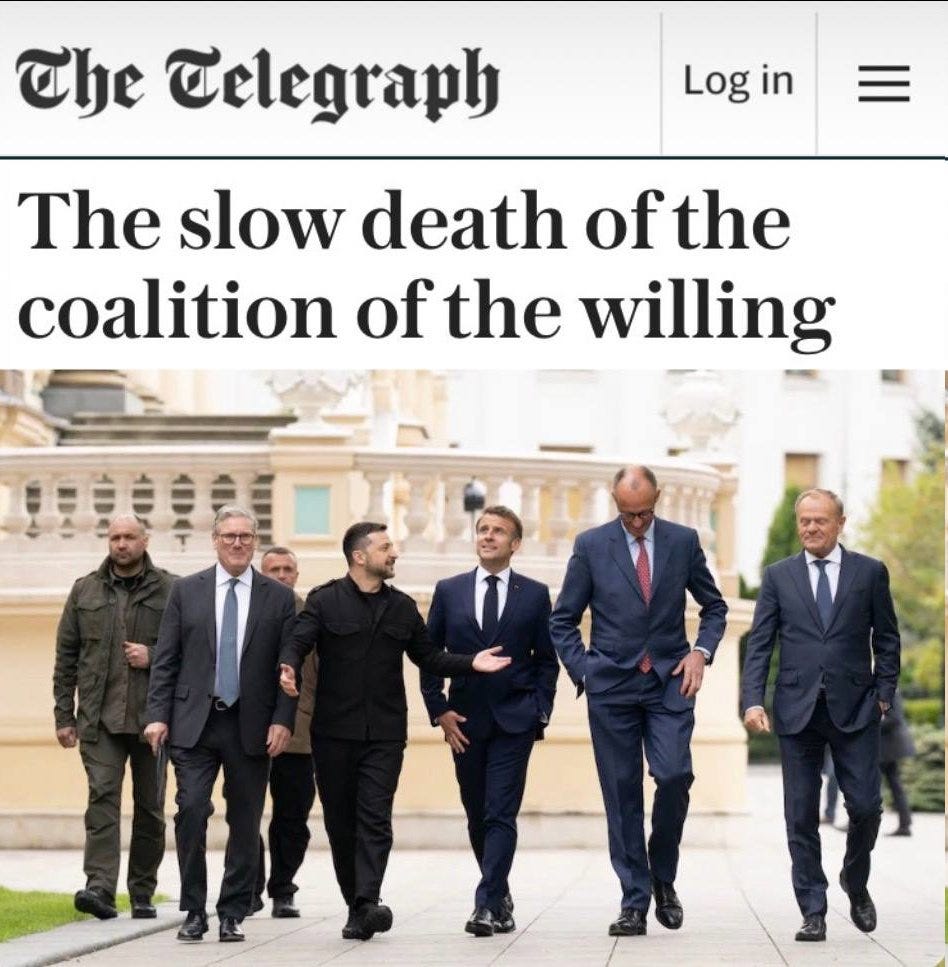
With Starmer gone, Macron facing his last year in office, and Germany’s Merz dangling by a thread, the club of Ukraine’s main cheerleaders is in tatters—and the future looks ever-less promising:
The domestic stability of candidates who could fill that void, such as Germany’s Friedrich Merz, remains in doubt. Meanwhile, leadership hopefuls who are more sympathetic to Russia, such as Marine Le Pen, wait in the wings and could reshape Europe’s support for Ukraine next year.
She has previously promised to remove France from Nato’s military command, lift sanctions on Russia and urge Ukraine to agree to a peace deal on Moscow’s terms.
Far-Left firebrand Jean-Luc Mélenchon, who is seen as one of her chief rivals in the ballot set for nine months’ time, has gone even further, pledging to withdraw from the Western military alliance.
As time goes by, it seems more and more that Putin’s strategic patience may be paying off, as the old hostile European structures slowly collapse like an iceberg calving into the sea.
But now, there is an even more dire threat on Ukraine’s horizon.
Over the last two days there has been a surge of articles confirming something we ourselves had posited here just a few weeks ago: that Russia’s new Rassvet satellite system (known as the “Russian Starlink”) is in fact already being positioned to allow some limited capabilities over Ukraine—and those capabilities will soon grow rapidly.
From a Ukrainian source:
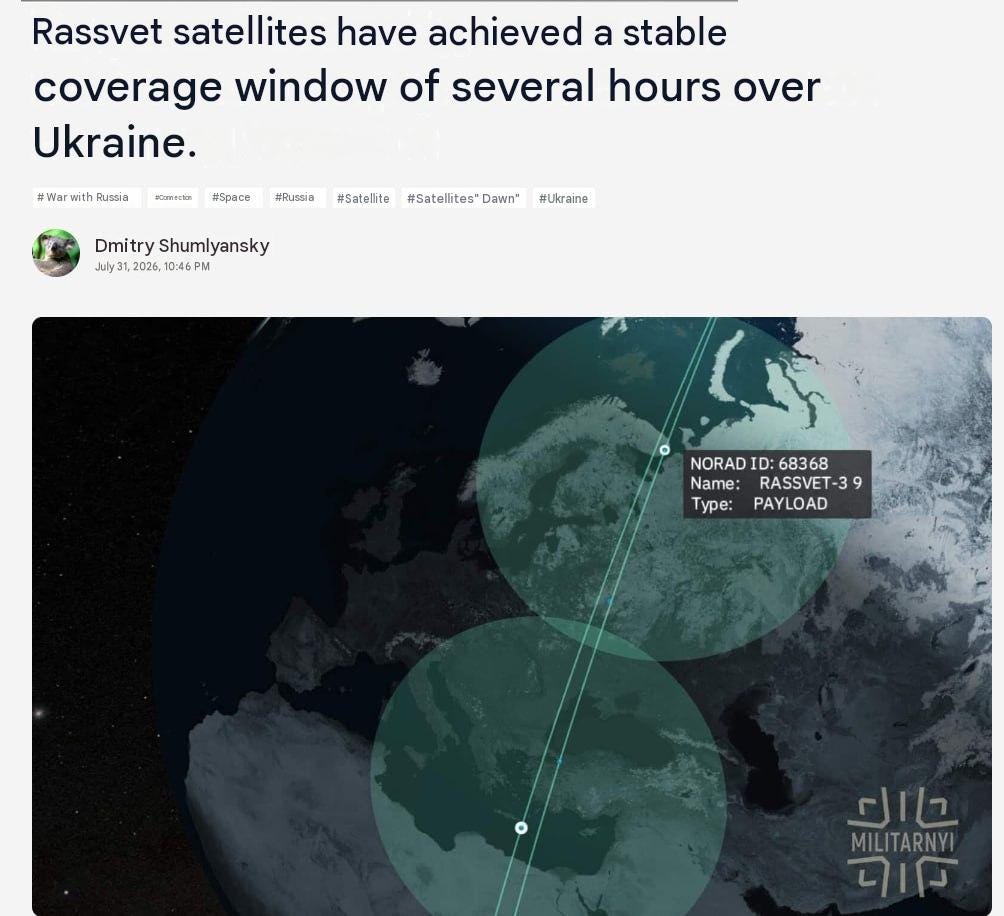
They urgently write that the satellites have already achieved two hour-long communication windows per day:
Russia’s Bureau 1440 Rassvet satellites already provide at least two” communication windows “ per day over Ukraine lasting more than an hour each.
Vladimir Stepanets, an expert in satellite communications, told Militarny about this after analyzing the trajectories of Russian satellites.
“We see that in fact a chain with good coverage has already been formed, which forms such good coverage about twice a day, but in fact there are more of these arrivals, that is, several such chains can fly with coverage of certain regions at intervals of about once every hour and a half. But what is important is that these satellites already provide quite dense coverage, “ he said.
Watch below:
“This could have serious consequences for the Defense Forces if they do not deploy effective countermeasures by that time.”
Detractors argue that Starlink has over 10,000 satellites in orbit, but:
That’s in order to get global commercial-level coverage everywhere.
As we had already explained, Starlinks are smaller and in lower orbits, and more of them are required.
The new Russian satellites are larger and in a higher orbit, which decreases the need for as many of them. Most importantly, they don’t need to have global coverage, but rather just coverage over Ukraine.
The Militarnyi piece also notes that Russia has finalized development of the actual satellite communications terminals as well, which look similar to Starlink’s ones:

According to open sources, the company has already completed the development of the basic version of the terminal and is preparing to launch mass production.
Given the characteristics of the terminals and the general context of the project development, we can expect that after mass production is established, they will quickly fall into the Russian troops. the likely use will not be limited to ground-based kits.
It is worth preparing for the appearance of such terminals not only at control points, vehicles or ships, but also on strike and reconnaissance UAVs. In the future, they can be integrated into platforms created on the basis of “Geran-2/3/4/5”, “Harpy” or other long-range drones. A similar communication channel can also be used for targeting cruise missiles, glider bombs and other weapons of destruction.
New estimates have proposed that Russia could launch enough satellites to have full 24/7 coverage over Ukraine by as early as 2027.
One analysis:
Regarding “Rassvet“ and Ukraine...
According to data from the N2YO service, the satellites are in orbits that allow them to pass within range of Ukraine four times a day. However, only during two or three of these passes do the satellites rise high enough above the horizon to provide stable communication with ground terminals.
During each pass, which lasts about an hour and a half for the entire formation, a “communication window” is created, during which the Russian Aerospace Forces could theoretically use satellite terminals to communicate and control kamikaze drones and unmanned aerial vehicles (UAVs).
At the end of July, the second group of 16 satellites was launched into orbit. If the current deployment rate is maintained, the satellites in the second group will reach their operational altitudes within October-November and provide two additional “communication windows.”
The officially announced schedule calls for the start of commercial operation in 2027. Previously, plans were mentioned to increase the number of satellites to 250 by 2027, to 730 by 2030, and to over 900 by 2035....
The 250 number was given by Serhiy Flash as requisite for having 24/7 coverage. If Russia reaches that by 2027 as some estimate, then Russia will have its very own fully native “Starlink” system to control drones of any kind at all distances, without requiring Belarusian “relays”, repeater tricks, mesh networks, etc. That’s not to even mention the revolution it would have on simple Russian battlefield networked communications and integrated battlefield management systems.
Given what we’ve seen with the trajectory Ukraine is on politically, diplomatically, and now militarily with the acceleration of Russia’s offensive campaign, the destruction of infrastructure and landlocking of the country via Odessa, as well as the surge in Russian ballistic missile production and total paucity of Patriot interceptors, we can say that 2027 could be a hallmark year that will see Ukraine truly begin to buckle, if not completely collapse.
It has been the main narrative for some time now that Ukraine’s major advantage over Russia has been the Starlink system. Not only has Russia increasingly learned to jam Ukraine’s own Starlink, and is progressively rolling out more of the systems able to do this, but now Russia is beginning to field its own analog.
By 2027 we may see Ukraine’s Starlinks increasingly ineffective, while Russia’s own begin to dominate, rescinding the last of Ukraine’s battlefield advantage amidst an unprecedented production overdrive of ballistic missiles which will be slamming daily into Ukrainian cities.
In conclusion: Ukraine’s outlook has never been worse, and Zelensky is left with nothing more than cheap tricks of increasingly targeting Russian civilians to “irritate” the public against Putin, as happened today when a Ukrainian drone slammed into a busy public beach in Gelendzhik.
Ukrainian figure Taras Chmut summarizes:
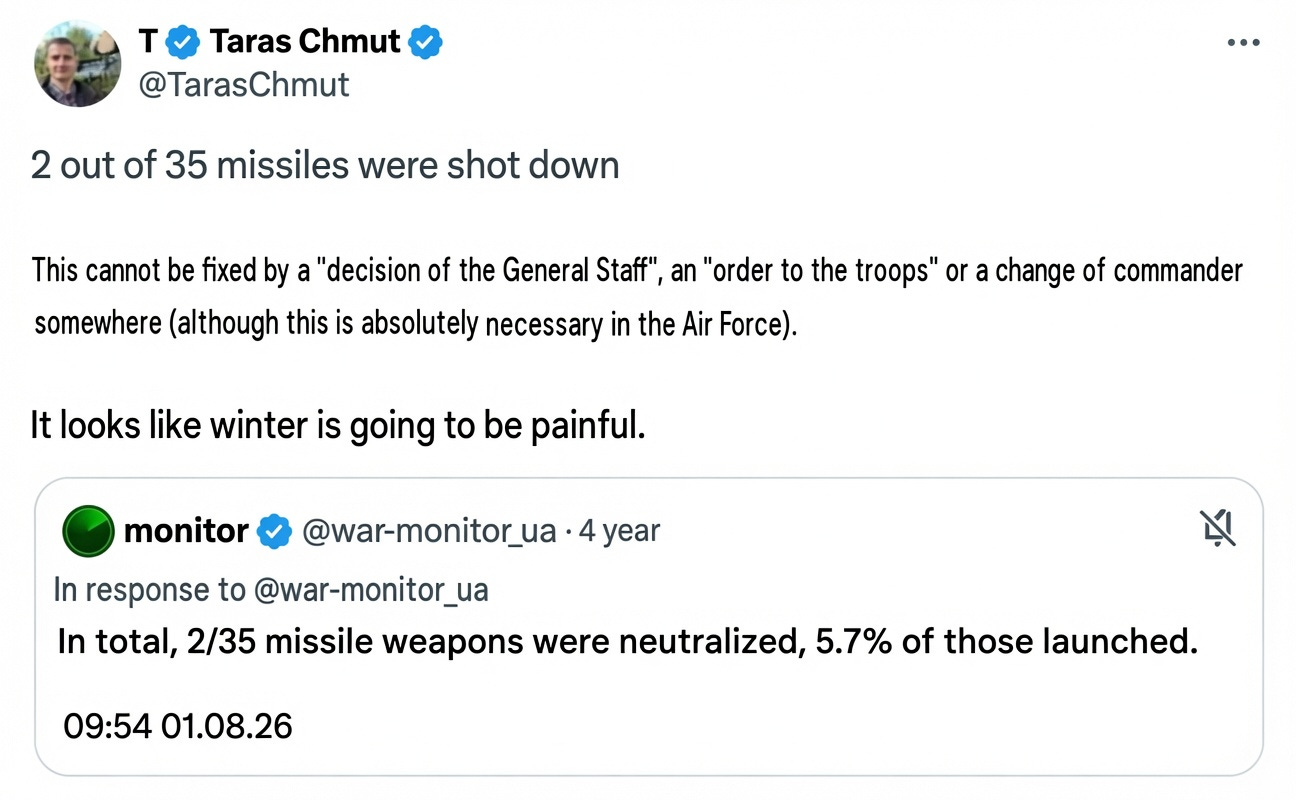
And a timely final post from one of Ukraine’s most prominent analysts, Bohdan Myroshnykov:
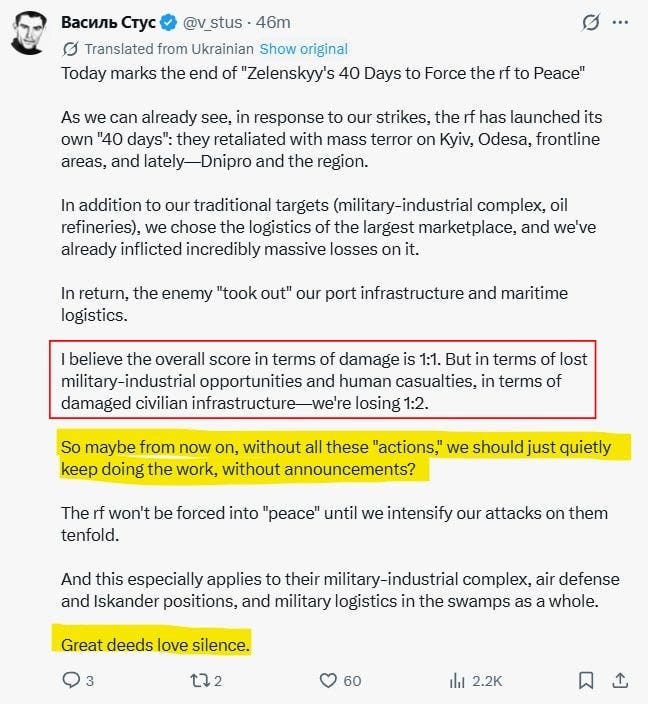
That’s a valiant attitude to have, but judging by Zelensky’s new ceasefire beg, we can assume even he comprehends that a “blow-for-blow” slug match against the Russian Titan would not work out in Ukraine’s favor.
But since there’s no other real choice, he’ll likely be forced to take it to its natural conclusion.
Your support is invaluable. If you enjoyed the read, I would greatly appreciate if you subscribed to a monthly/yearly pledge to support my work, so that I may continue providing you with detailed, incisive reports like this one.
Alternatively, you can tip here: buymeacoffee.com/Simplicius